

Table of Contents
01
of 06
Introduction
Morocco, a land of rich cultural heritage and diverse linguistic traditions, is home to a unique dialect known as Darija. This colloquial form of Arabic serves as the primary mode of communication for Moroccans in their daily interactions. Understanding Darija not only facilitates effective communication but also offers deeper insights into the Moroccan way of life.
02
of 06
Historical Background
The evolution of Darija is a testament to Morocco’s intricate history. Rooted in Classical Arabic, Darija has been significantly influenced by indigenous Berber languages, reflecting the country’s native Amazigh culture. The lexicon further expanded with the introduction of French and Spanish during the colonial era, resulting in a rich tapestry of linguistic elements that define modern Darija.
Vocabulary and Influences
Darija’s vocabulary is a mosaic of its historical interactions. While the foundation remains Arabic, it seamlessly incorporates Berber terms and a plethora of French and Spanish loanwords. For instance, the word for cheese is “fromage,” directly borrowed from French. This blend renders Darija distinct from other Arabic dialects, embodying Morocco’s multicultural essence.
Pronunciation and Phonetics
Pronunciation in Darija presents unique challenges, especially for non-native speakers. The dialect features sounds and intonations that differ markedly from both Modern Standard Arabic (MSA) and other Arabic dialects. Regular listening and speaking practice are essential to master these nuances, facilitating more natural and effective communication.
Grammar and Syntax
Darija exhibits a flexible grammatical structure. Unlike MSA, which adheres to strict grammatical rules, Darija allows for regional variations and colloquial expressions. This adaptability reflects its primary use in everyday conversations, making it a dynamic and living language that evolves with societal changes.
03
of 06
Regional Variations
Within Morocco, Darija varies across different regions. These variations can manifest in pronunciation, vocabulary, and even grammatical structures. For example, northern regions may exhibit stronger Spanish influences, while central areas might retain more Berber elements. Understanding these regional differences is crucial for learners aiming for comprehensive proficiency.
04
of 06
The Importance of Learning Darija
Cultural Integration
Learning Darija is pivotal for genuine cultural immersion. It enables deeper connections with locals, fosters mutual respect, and enriches one’s experience in Morocco. Whether navigating bustling souks or sharing stories over mint tea, proficiency in Darija opens doors to authentic Moroccan experiences.
Practical Benefits
For expatriates, travelers, or business professionals, proficiency in Darija facilitates smoother interactions in various settings, from negotiating prices to understanding local customs. It also aids in avoiding potential misunderstandings that can arise from language barriers.
Challenges in Learning Darija
Several factors can make learning Darija demanding:
- Limited Structured Resources: Unlike MSA, Darija has fewer formal learning materials, making it challenging to find structured lessons.
- Pronunciation Nuances: Certain sounds in Darija can be tricky to pronounce, especially for non-native Arabic speakers.
- Regional Variations: The dialect varies significantly across Morocco, so a phrase learned in one region may not be used in another.
05
of 06
Introducing GoDarija: Your Companion in Learning Darija
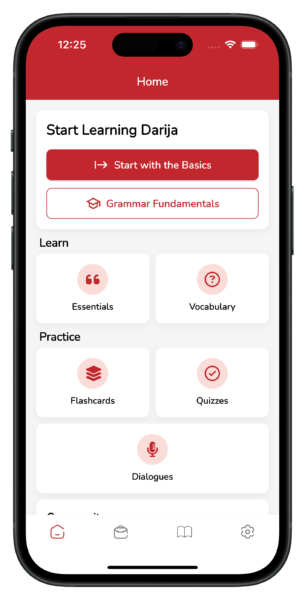
To address these challenges, the GoDarija app emerges as an invaluable tool for learners. Designed with user-centric features, it offers:
- Native Audio: Authentic pronunciation guidance through clear recordings by native speakers.
- Interactive Quizzes: Engaging assessments that adapt to individual learning paces, reinforcing knowledge effectively.
- Visual Flashcards: A spaced repetition system to master vocabulary and phrases efficiently.
- Daily Phrases: Practical expressions curated for real-life Moroccan conversations.
- Essential Vocabulary: Focus on high-frequency words integral to daily interactions.
- Real Dialogues: Exposure to authentic conversations reflecting everyday scenarios in Morocco.
These features collectively ensure that learners can navigate the intricacies of Darija with confidence and ease.
Download GoDarija Today:
Android: https://play.google.com/store/apps/details?id=com.godarija.app
iOS: https://apps.apple.com/us/app/godarija-learn-moroccan-arabic/id6741084589
06
of 06
Conclusion
Darija is more than just a dialect; it’s a reflection of Morocco’s rich cultural mosaic. While learning it presents challenges, the rewards of deeper cultural integration and enriched experiences are immense. With tools like the GoDarija app, embarking on this linguistic journey becomes both accessible and enjoyable.











Comments 1